
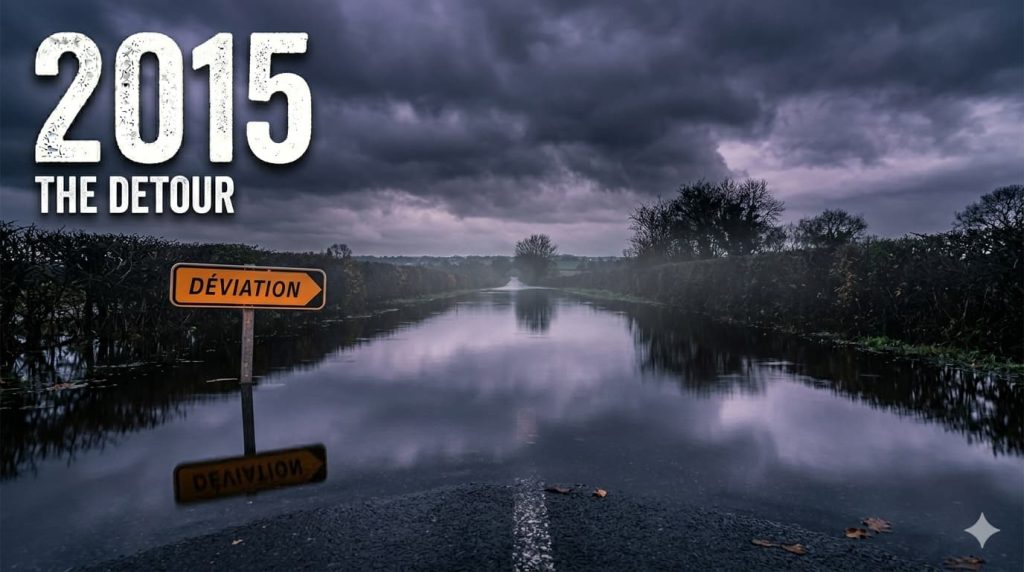
This year brought significant changes in my personal life that also closed a long chapter in my running: at the end of 2014 came a move to a new city, a new job — and new running ground. Towards the end of the year I started scouting out routes, at first without much success. Since we were in a small town, it was obvious that criss-crossing the town on foot wouldn’t yield a five-kilometre stretch suitable for running, so I turned to Google Maps. On the map I found a canal with what appeared to be a path running the entire length of it for many kilometres. The path did exist — but I only ran it once, since it was suitable at best for the most determined of hikers: it was covered in mud from start to finish. The shoes I had broken in just a few weeks earlier had to be washed — something I normally do only once in the 800–1,000 km range, or not even then if it isn’t strictly necessary (washing is allegedly bad for running shoes; I prefer a thorough clean once a month instead).
Eventually I found a route that worked: a lightly trafficked country road leading out of town through alternating woodland and open fields, runnable at any distance I chose. There were days when I covered ten or fifteen kilometres without encountering a single car. The road surface was good — and although a dog would occasionally dart out from one of the farms to bark at me (nothing like the peaceful ones I’d seen in Sofia), the owner was always nearby and would call it back. My standard distance shifted to 11 km because of the route. Although I hadn’t planned a spring marathon, from April I started throwing in longer runs now and then to keep my marathon fitness, just in case the urge struck. Once, for example — perhaps unconsciously making up for the marathon I’d missed — I ran 28 km in April simply because it felt right, even though I normally stayed around 20.
Running Through a Flood
There were several small rivers and streams nearby, and the route crossed a number of bridges. In May, an exceptionally wet spell set in, triggering severe flooding across the waterways — every river burst its banks. There was a red alert in force across the entire département. One of the rivers submerged a whole campsite, fortunately not yet open for the season. It was striking to see the benches along the riverside promenade — where it had been so pleasant to sit — simply disappear beneath the water. This didn’t particularly disrupt my running; as long as it wasn’t bucketing down, I went out as usual. The flooding lasted for days. At one point I was already squeezing through a narrow strip across a submerged section of path. Then, mid-run on the return leg, I got a shock: I could no longer pass at all — the passable path had vanished while I’d been running the stretch beyond it.
I stood there for a moment, staring in bewilderment, wondering what to do. The water couldn’t have been too deep, but flooded sections are treacherous — you can’t see what’s beneath the surface. Where would I step? Into a ditch, or onto something swept there by the current? And I was still several kilometres from home — squelching back in soaking shoes would have been far from pleasant. After a moment’s thought I turned back and jogged along, trying to get my bearings (I didn’t know the area well yet, having only been running there for a few months) to find a way around the flooding. On the far side of the submerged road was a floodplain — a field completely under water — and in the other direction, fenced-off farmsteads, several of which were also already partly submerged. Scanning the landscape as I went, after about a kilometre I was lucky enough to find a stretch of higher ground where, covering a few hundred metres past flooded areas, I was able to rejoin the flood-free section of the route and run home. Though the shoes were so muddy they had to be washed again.
A Cancelled Marathon — and a Last-Minute Replacement
The flooding receded a few days later and everything fell back into its normal rhythm. I kept up the long runs, and on several occasions I surprised even myself with the pace I was managing. At marathons and half-marathons I’d been running my halves in just under two hours, but at this point I was regularly running 20 km around 1h43 — a significantly better time by comparison. It was good to see that my fitness hadn’t declined.
My enthusiasm for marathons, which had dimmed somewhat, also began to return — and during the summer I decided that my next marathon would be the Marathon d’Orléans, in November. I’d have just enough time to prepare properly, and that way I wouldn’t close the year without a marathon.
In between there was another trip in late summer to my former home country, where I continued my training. The journey went via Austria — a country I’d already run in — but I added a new city to my running map: I ran one morning in Linz. It seems I need to be careful in that country, because what I’d experienced in Vienna happened again there, though this time I didn’t even have time to run home… Perhaps I’ll tell that story in a separate post one day.
Back home, September and especially October were all about fine-tuning for the November marathon. What I didn’t know then was that I would never run that race: a series of terrorist attacks in Paris brought the entire country to a standstill, and all outdoor public events were cancelled nationwide for security reasons. My marathon was among the casualties. I was frustrated at first — a marathon demands months of preparation and logistical planning, and having it cancelled the day before was infuriating. There was nothing I could do about the situation, but I didn’t want my training to go to waste. I scoured the entire country’s race calendar and found exactly one remaining marathon that year: in early December, and within reachable distance. I signed up immediately and began preserving my fitness for that race.
A Winter Marathon by the Loire
The start and finish were at a château on the Loire, but the timing was unusual for me — mornings were already bringing frost, and I had never run a full marathon in such cold. Clothing choices, tactics, warm-up routines — none of it was familiar territory. I read up, gathered what information I could, and eventually the day arrived. Fortunately, the forecast for race day called for around 10°C after the cold morning start, which was a relief. The sky was overcast and the early morning was bitterly cold: I was astonished to see some runners lining up at the start in sleeveless vests and what were essentially shorts. The race pack included a throwaway long-sleeved top — handy for anyone wanting to run the distance in short sleeves afterwards. (I went with a full long-sleeve outfit and wasn’t warm at all.)
We weren’t many — a few hundred, certainly not a thousand: this was a very small marathon, but I was genuinely glad to have the chance to run it that year. At the start, I thought: this is the last marathon of the year in the entire country — and I get to be part of it. I was also curious to see how missing the spring marathon had affected my form.
The course was excellent — again winding through small towns and partly through open countryside, occasionally on unpaved tracks. With music in my ears the time passed quickly, and as I’d signalled at the end of Berlin, I was focusing on enjoyment rather than time. There wasn’t the same atmosphere as a big-city race, but the villages turned out along the roadside to cheer the runners on — it was good to see. Some residents had even set up impromptu refreshment stations.
Towards the end there were a few unwelcome surprises. I kept running steadily — no walking, holding my own pace — but my legs were very heavy and at around the 37 km mark my calf cramped up. I had to stop; it really hurt. I tried to stretch it out, walking slowly — eventually it came right and I ran again. About a kilometre later the other calf cramped. I took that as my body beginning to signal that it had had enough running for the day. There was no point analysing whether I’d eaten or drunk enough earlier — that was the situation, full stop, and I had to reach the finish line, cover those last few kilometres.
After the 41 km marker, I was desperately waiting for the 42 km sign — but it never came. It felt like it should have appeared long ago, yet I couldn’t see it anywhere. Everyone was running, waiting for the finish, which eventually appeared (or rather the bend leading to it) — but the 42 km marker was nowhere to be found. The finish line came first. I remain convinced to this day that that marathon was longer than 42.195 km, and that the organisers simply didn’t want to demoralise the runners by showing them how long that final 195 metres actually was — so they left the sign out. At the finish everyone was happy, and done. So was I — though it’s just as well I hadn’t been trying to set a personal best, because I’d never have known how far I’d actually run (Time: 04:03:47).
A small celebration at the finish, some rest — and the year and its last marathon were over. I’d been part of it.
The rest of the year was just easy running and recovery — and mentally I was already preparing for the next marathons. I decided that the following year I’d go back to two a year. Those two turned out to be the last ones: the seventh and the eighth.
One more event belongs to the story of 2015. From my home country we returned with a greyhound puppy, taken as a companion for our whippet, who was five years old by then and had made it abundantly clear she had no intention of ever running with me. I was hoping a ‘real’ greyhound would be different. He was. He can be seen with me in the website’s opening photo, taken a few years later — but that’s a story for another post.
2015: 301 runs / 3,822 km
Since 2002: 3,218 sessions / 34,213 km