
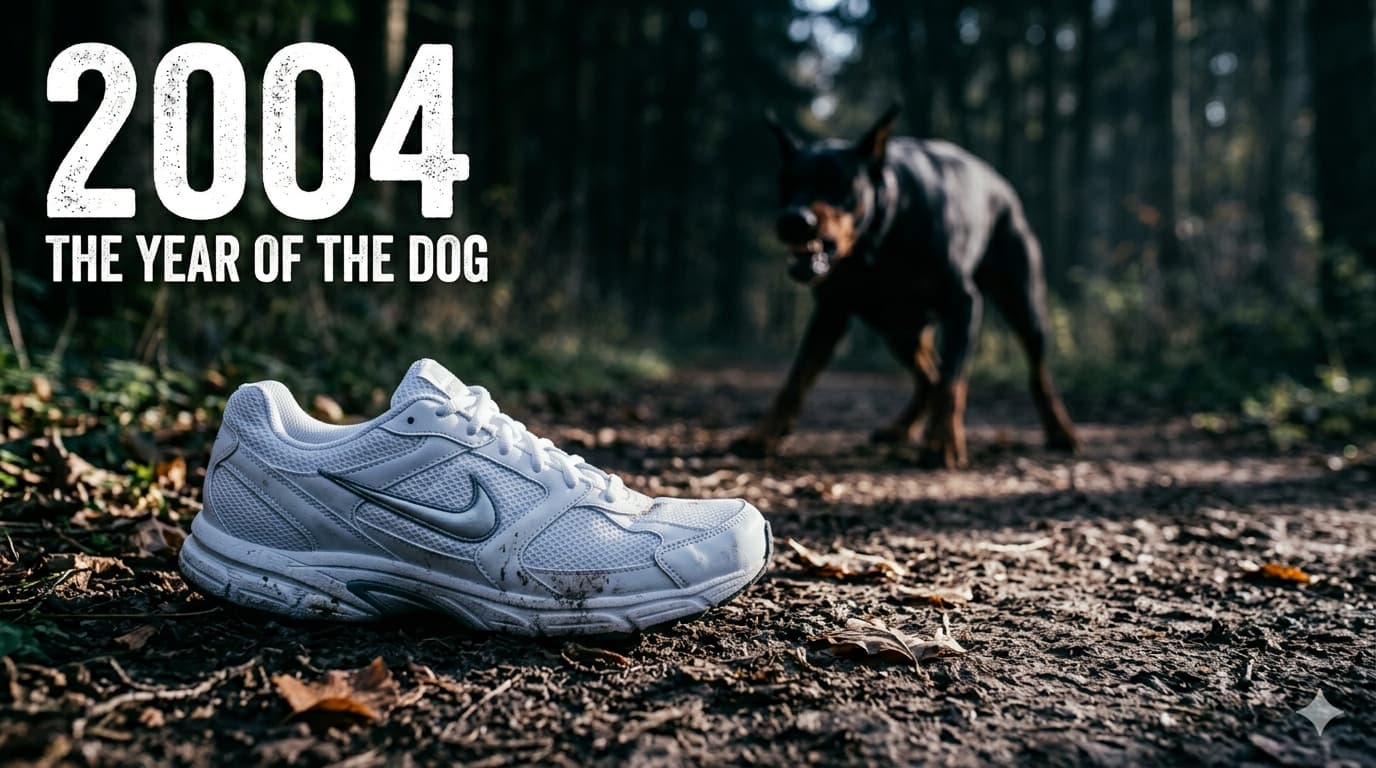
By 2004, there was no longer any question. Running was mine.
January proved it. Twenty runs, 130.5 kilometers, in the middle of a hard winter. I was learning the fine art of running in snow and ice — what works, what doesn’t, what sends you home after 150 meters. But I wasn’t stopping.
That January I also discovered something that has stayed with me ever since: morning runs. I noticed that on days when I ran before work, I was calmer, more balanced, more patient for the entire rest of the day. The effect was consistent and unmistakable. I’ve run at many different times of day over the years — sometimes mornings for years, sometimes evenings — and each has its own character. But the morning run has a particular flavor I first tasted that winter. Another point in running’s favor over cycling, by the way: on a dark January morning at minus ten degrees, you’d have to be slightly mad to go out on a road bike with its narrow tires, no roadside lighting, potholes invisible under the frost. Running, you can do anywhere, anytime, in almost anything.
As spring arrived, the bike came back out and the running shrank again — down to once a week through summer. But this time, stopping never crossed my mind. After the knee trouble of late 2003, I had settled into a comfortable range of 5.5 to 7.5 kilometers per run. Not too much, not too little. The pain didn’t return.
That year I also discovered something that transformed running for me entirely: listening to something while I run. I know runners who prefer silence — who use the time to think, to meditate, to just be. I am not one of them. My mind needs an anchor. In the early days it was radio programs. I would time my runs to coincide with my favorite broadcasts — back then, streaming and podcasts weren’t yet the natural thing they later became. It worked perfectly. The program captured my attention, the kilometers passed without my noticing, and I arrived home having both finished my run and heard something I would never have managed to listen to at home. This was the beginning of something I only fully understood later: running as daily mental escape. A reset. A space that belongs to no one else. I owe an enormous amount to that discovery, and I still feel it every single time I go out.
The rest of the year passed quietly. And then came October.
Runners have enemies. The most committed of these is the dog.
Dogs feel an irresistible urge to attack moving humans. Even leashed dogs in urban areas will lunge unexpectedly at a passing runner — which is why dog owners often dislike runners too, since controlling a large dog mid-lunge is not always easy. Running through suburban streets, I had long since stopped paying attention to dogs barking behind fences. There was one crumbling house with a broken fence where a German shepherd occasionally appeared, but beyond the noise it never seriously threatened me. I’d slow to a walk, give it a wide berth, move on. Packs of stray dogs were a different matter — four or five together can be genuinely dangerous. I never got close to any; if I saw them, I changed direction. The route adjustment was always worth it.
Cycling had its dog moments too. Passing farms, one or more would sometimes burst out suddenly. On a bike you can outrun them, and I learned to approach known danger zones at higher speed. They didn’t always come out — which meant that when they did, it was always a surprise.
But nothing had prepared me for what happened on a foggy late-October evening, beside a cemetery.
It came from nowhere. A medium-large dog — roughly the size of a vizsla — appeared directly in front of me in the dim streetlight. Scruffy, not the kind that had just slipped out of someone’s home. I knew the cemetery used guard dogs after closing time, and assumed it was one of them. It stopped and stared.
I did what I always did: slowed to a walk, gave it a wide arc, passed calmly. It worked. I continued my run.
On the way back, I took the same route. I watched carefully — nothing. Then it appeared again, from nowhere. This time it was tenser. It growled. Its expression said something like: “You again? Still here?” I went back to the same approach: slow, calm, wide arc, steady pace. It watched me the entire time without moving.
I had almost passed it. I was starting to relax.
Then it charged.
I accelerated — but not fast enough. I felt it bite into my left thigh from behind. I spun around and shouted at it to back off. It barked and growled, standing its ground. I kept backing away slowly, and after a few meters it stopped following.
I knew immediately it had broken skin. My running trousers were torn.
I wasn’t far from home. Back inside, we assessed the damage: a coin-sized tear in the fabric, what appeared to be a single tooth — probably a canine — that had punctured the skin. A small amount of blood.
It was the eve of a public holiday. Eight in the evening. The only option was the emergency medical service. I was furious, but there was no alternative. They cleaned the wound and told me clearly: get the dog’s vaccination record, bring it to the public health office, or start a rabies vaccination series immediately.
The next day was the holiday. The day after, I went to the cemetery and told the guard what had happened. He was certain it couldn’t have been one of his dogs — they couldn’t get out. He showed them to me. I couldn’t identify any of them with certainty.
So we went to the public health office. Their conclusion was immediate: start the vaccination series now. There is no other defense against rabies. The good news, they told me, was that it was no longer injected into the stomach — just the arm. Five years of protection, ten if you get the booster.
I got the series. Not the booster. Fortunately, nothing similar has happened since.
I kept wearing those patched trousers afterward. Every time I put them on, I thought of that evening. I got off lightly.
I bought an ultrasonic dog repeller after that, carried it in a waist bag on every run — and never encountered a single dog while I had it. Eventually I left it at home. Dogs still crossed my path occasionally after that, mostly leashed ones lunging at my ankles. One or two made contact. A brief exchange of words with the owner, and that was that. Nothing as memorable as October 2004.
That year I learned two more things about what it means to be a runner: winter conditions, and dogs.
The year ended quietly and actively. November and December: two to three runs per week. And for the first time, I crossed 100 runs in a single calendar year.
108 runs. 679 kilometers. (Total since the beginning: 222 runs, 1,179 kilometers.)