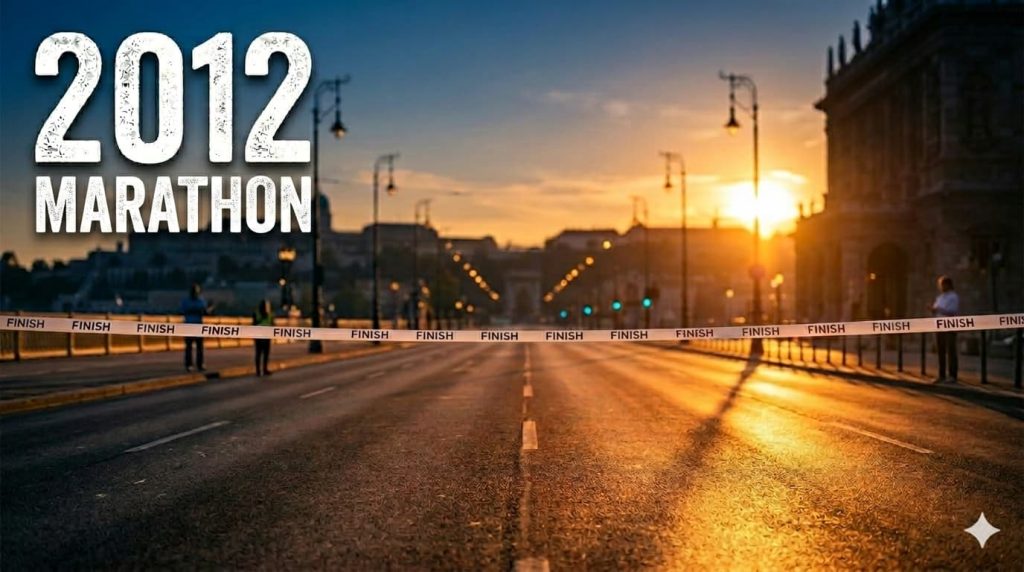
This year was a milestone in my running life. Something happened that I couldn’t have imagined for the longest time. By now I’d been running for ten years — a significant anniversary in itself — but I managed to celebrate it in a way it deserved.
The year began in the usual way, with a small celebration in late January: I reached my two thousandth run. Nobody else noticed, but I was thrilled — especially because I’d doubled my count in just over three years, far faster than the first thousand. In early February, a ten-to-twelve-day cold snap arrived: I logged runs at minus eight, even minus ten, in dry conditions. The cold-weather gear I’d recently invested in proved its worth.
The Spark
Early in the year, I watched a programme that followed five people over several months as they prepared for the New York Marathon. One of them was significantly overweight and had almost no running background. I recognized my former self instantly. I told myself: if he can do it, then after ten years of running, I have to do it. And he did — over seven hours, well beyond the cutoff pace, but he finished. I watched the footage of the streets, the crowds, the suffering on the runners’ faces as they pushed on. The decision ripened inside me: I would do it that same year.
I looked through the calendar of European marathons, comparing profiles, elevation, scenery, organization, and field sizes. I chose Budapest, scheduled for early October. My running partner from the previous year agreed to train for it too — he’d run that same marathon some twenty years earlier but hadn’t entered one since. We would do it together.
The Preparation
I searched for training plans online. There were plenty, but oddly none of them fit me: with ten years of running and sixty-plus weekly kilometers behind me, every plan I found was designed to improve race time, not to prepare someone for their first marathon. I read a theory that says whatever you run per week, you can run in a single effort. By that measure, I was already well past marathon distance. I also read that every week should include a long run and a rest day, so I restructured my schedule accordingly.
The first long runs started in May: sixteen to eighteen kilometers, sometimes twice a week. That same month, I ran a half marathon without any trouble at all. I was genuinely surprised, and a little incredulous, that a distance other people train specifically for fit comfortably into a weekend run. My only goal for the full marathon was modest: finish in under four hours.
Through the summer, the distances kept growing: twenty-five, twenty-eight, thirty-one in August, then a full dress rehearsal of thirty-four kilometers in mid-September. After that, one more half marathon, then tapering. For the thirty-four-kilometer run, I placed water bottles at various points along my usual routes, and when they ran out, I popped into our apartment as I ran past to refill.
Race Day
The afternoon before: the obligatory pasta party, picking up my race number and shirt. The next morning: the start. I was wired with excitement, quietly anxious about whether I’d actually make the distance — forty-two kilometers, after all. The furthest I’d ever gone on foot.
Standing at the start line after the group warm-up, waiting for the gun, I felt something that startled me: I was tired. Not bursting with pre-race energy, but drained. The roughly two thousand kilometers of preparation had taken their toll. What I wanted, honestly, was rest. But we set off together, the two of us, side by side, encouraging each other, matching pace, talking, savouring the experience.
At twenty-one kilometers we separated. My momentum was stronger; he didn’t want to hold me back. From there I ran alone, earphones in, music on, as if I were running at home. We’d skipped the first aid station in the heat of conversation, but I made sure to use every one after that.
My playlist was the usual mix plus a few new additions I wanted to test. One of them was a Depeche Mode album — perhaps not the ideal marathon soundtrack. It didn’t exactly fill me with forward drive, and right around thirty-three kilometers, I hit the Wall. I slowed to a walk. I was shattered. I knew exactly what was happening — I’d read about it extensively — and I’d never encountered it at thirty-one or thirty-four in training. I also knew the golden rule: don’t start fast, save your reserves for after thirty-five. I’d been careful about that. And yet.
I read somewhere that the marathon truly begins at thirty kilometers. There are still twelve to go. Twelve kilometers is nothing for me on a normal day — but with thirty already in my legs, it’s a different equation entirely. Walk — run — walk — run. I switched music, pulled myself together, and found my rhythm again. I noticed more and more people walking, many of them faces I recognized from the early kilometers when they’d surged past me. I alternated for about one or two kilometers, then ran the last seven or eight straight through.
The Finish
I crossed the line. Four hours and five minutes. Beyond my dream target, but I’d done it. I was a marathon runner, for life. From now on, I could say: I did it. What I felt was euphoria — almost literally.
Instead of resting, I waited at the finish for my friend. I didn’t know how long he’d be. He appeared an hour later, past the five-hour mark, but he’d done it too. I was barely holding on by then — he came in just in time. Then: lying in the grass, legs pulled up, completely stiff. In the finisher’s bag there was a lemon beer. Never in my life has a drink tasted that good. I will never forget that sensation. I drank the whole thing in one go.
The euphoria lasted days — alongside staggering muscle soreness. Worth it for that alone. Later, I noticed the high got shorter with each marathon. By the fourth, it barely appeared at all — just a faint echo of the first time, to my great regret.
What I Learned
I took a week off afterward, because that’s what I’d read. I shouldn’t have been so rigid — it felt far too long, and the next time I shortened it. That was one lesson.
The most important lesson was this: no more training plans. From now on, I listen to my own body. I never wanted to arrive at a start line exhausted again. I knew I didn’t need to run thirty-plus kilometers in training — completely unnecessary for me — and recovery would follow my own instincts, not someone else’s schedule. After ten years, I knew my limits.
I’d originally planned to run just one marathon, to be able to say I’d done it. But crossing the finish line, I already knew it wasn’t the last. That same month, I started looking for the next ones. I found two for the following year and signed up as soon as registration opened.
November and December were already spent preparing for the spring marathon: one long run per week, seventeen to twenty kilometers. I felt sure it was enough. Because one goal remained: finishing in under four hours. The following year, I’d have two chances.
2012: 319 runs / 3,790 km
Since 2002: 2,293 sessions / 22,812 km