
This was one of the most varied years of my running life. It began under familiar conditions, then in February came a move back to my home country. We made a small detour through the Pyrenees, where I managed two runs: an eight and a seven, in my rain shoes — the ones I’d been wearing since early January to use them up before retirement. I could feel the rubber hardening. Before parting with them, I ran enough to reach their average lifespan: roughly fourteen to fifteen hundred kilometers. Their last steps were on mountain roads above a thousand meters, in a dead-end village at the end of the road. The mountain routes were rarely level — steep downhill for half the distance, then climbing all the way back. Fine as a one-off, but I wouldn’t have wanted it every day. No lighting on the road, minimal traffic, and something that took me a while to identify: the Pyrenees felt strange to me. I eventually realized it was the absence of pine forests.
A Year of Moves
After the Pyrenees, a multi-day drive, then arrival. The first weeks were spent in the capital, then for a few months we house-sat a rural property in a hilly region. That meant mountain running again, alongside the running partner I’d done my first marathon with five years earlier. The air and the wooded surroundings were wonderful, but the constant up-and-down didn’t win me over. There was a valley with a long, flat, paved road — virtually no traffic — but reaching it meant climbing through plenty of hills first.
Then another move in late spring, this time for work, to the far end of the country. And that’s where the best running terrain of my entire life was waiting.
The Forest
From the edge of the town, a well-known long-distance hiking trail began — its first section practically passing our front door. Paved road to the edge of town, then good-quality dirt track that led, about a kilometer later, into dense forest. The path continued for what felt like forever, virtually flat. For my daily ten to twelve kilometers, only the first two were in the built-up area. From there: runner’s paradise. Cool in summer, sheltered from sun and rain by the canopy. Breathtaking in winter under fresh snow. Occasionally there were forestry works, hunting days, muddy patches after heavy rain — but the most beautiful runs of my life happened here. I had two years of it.
Once, I ran past a group of hikers and one of them remarked that I had a gorgeous running terrain. I imagined he was a runner too, looking on with envy at someone who got to do this every single day.
When the snow was too deep in winter — not uncommon in that area — there was an alternative: a small boating lake nearby, where I could run laps in a similar setting.
Running with the Greyhound
This is where I started running with my then two-year-old greyhound. Once we were out of town, I’d let him off the leash and she’d bolt into the forest, across the clearings, running huge loops alongside me. You could see he was happy — truly in his element. A few times he nearly gave me a heart attack, and every run with him was more stressful than running alone, because I had to keep an eye on him. But there were no serious incidents.
Occasionally she’d plunge into the thick forest — perhaps she’d spotted game, there was plenty — and vanish. I’d call for him: silence everywhere. Usually I’d keep running, because somehow he always knew where I was and would reappear on the path a few minutes later. Once, I gave up and started heading home to come back for him by car — but there he was, a few hundred meters ahead. He always knew. He never truly disappeared. A sweet, good-natured dog, a little nervous around other dogs — he’d bark threateningly but never bit.
One time, he was trotting beside me, sniffing, when a fawn burst out of a ditch. She took off after it instantly. The poor fawn was terrified, crying quite loudly, with a greyhound panting behind it — one who visibly had no intention of harming it, just thrilled that finally someone could run at his speed. They disappeared into the forest and I worried about how it would end — but he trotted back onto the path after a while and we carried on. A good adventure for him; I hope the fawn wasn’t too shaken.
Over the two years, I ran into the forest rangers a few times. They warned me that if they saw the dog off-leash again, they’d shoot him. I researched this thoroughly and found that under certain conditions, they legally could. From then on, I was extremely careful: I figured out which stretches were safe and only let him run free there. On the hunting-risk sections, he ran on the leash beside me. He accepted it, but he was only truly happy when he could run at his own pace. Watching him run was extraordinary: he seemed to float through the air. He’d accelerate in an instant and cross enormous fields in seconds — one moment a tiny dot at the far end of the meadow, ten seconds later panting at my feet.
Generations of his ancestors hadn’t hunted, but plenty of old instincts remained: a few times he drove me mad by rolling in carrion, in other animals’ droppings, in who knows what else. The smell was horrendous. Shampoo baths followed, though sometimes the odor lingered for days.
What I envied about her was his “factory-fitted Gore-Tex coat”. If he plunged into mud at the start of the run, legs caked up to her chest — which on a long-legged greyhound is saying something — by the time we got home, everything had dried and simply fallen off. As if it had never been there.
The Wildlife
In that forest, besides the deer, I encountered wild boar and stags on an almost weekly basis. Sometimes from very close — some wouldn’t move until I was just meters away. Once, a massive stag stood in the middle of the path; when I kept running toward it, it vanished into the darkness of the forest in a single three-meter leap. The forest was predominantly pine, with a wonderful scent year-round.
On longer runs, there was a section in summer thick with horseflies, drawn magnetically to sweaty skin. In the driest, hottest months, I avoided that stretch entirely.
Morning Magic
Most of my runs here were in the early morning, before work. Incredible experiences. On the way back, I sometimes watched the sunrise through the trees and the clearings. In winter, after an overnight snowfall, I’d be the first person into the forest — nothing but the pristine snowy landscape and the untouched snow, casting an almost daylight glow.
What I didn’t love were the hunting days. Not just because the roads were closed, but because afterward I could almost feel the forest filled with pain. The gutted remains of the game were left on the roadside in the bloody snow, for the wild boar. A terrible sight. Mercifully rare.
Belgium and the fine print
In autumn, I added another country to my running map: a few days in Leuven for work. Belgium has an excellent cycling network, ideal for running. The cyclists were patient. At the hotel, though, I faced one of running’s less-discussed inconveniences: the windows couldn’t be opened. Air-conditioned rooms, no way to dry sweat-soaked running clothes without filling the room with their scent. An open window solves this easily; a sealed one creates a real headache. Running produces unexpected situations off the course too.
I was forty-eight that year, and fifteen years of running were beginning to register in my body. An occasional sharp pain in the knee or ankle, a sudden calf strain that forced me to walk home — these sometimes meant a few days off. But not inactivity: that’s when I discovered Nordic walking, which I could deploy any time as a substitute, slowing the fitness decline. The terrain was perfect for that too.
The Cover Photo
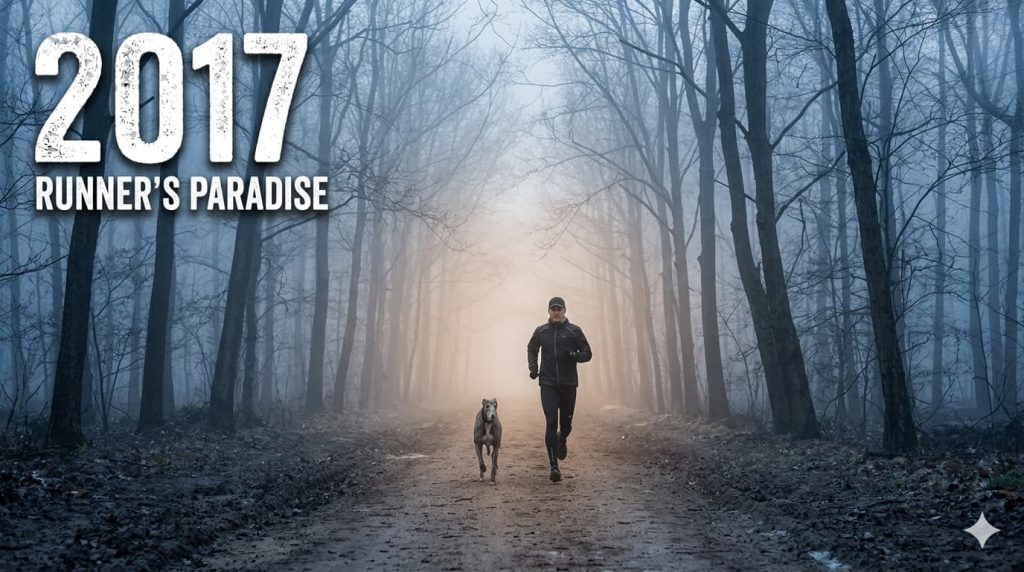
The cover photo for this year was taken on Christmas Day: running out of the forest, heading home. I love this image. Even the overcast, misty mood brings back those happy runs, alone and with the dog. I didn’t always take him, of course, but over the time we lived there, he joined me a hundred and eighty-two times.
By the end of the year, I had nearly run the circumference of the Earth. That’s almost a thousand marathons’ worth of distance.
2017: 300 runs / 3,219 km
Since 2002: 3,822 sessions / 40,954 km