
The Forest’s Farewell
For the first three months, I still had the forest paradise. But just as spring arrived, another move was waiting: a big city, a new job, a new way of life, another training programme. Everything changed again.
The forest said goodbye with a gift. One evening in March, I could only run late, and it was already getting dark. A gorgeous full moon hung in the sky, perfectly framed above the silhouettes of the pine trees. I stopped and stared for minutes. I didn’t have my phone, and it probably couldn’t have captured what I saw — but I wish I’d tried. I’d seen something like it once, twenty-five years earlier, in Transylvania. That image stayed with me forever. No artificial light, no human presence to spoil the landscape. This one would stay with me too.
Welcome to the City
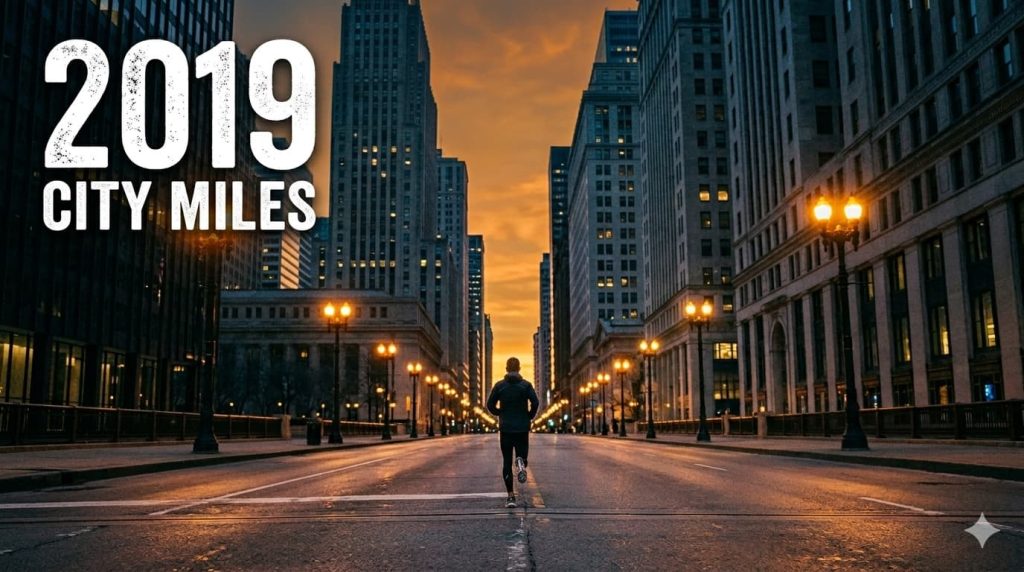
The move fell on the last day of March. April 1st: new job, new running route. I already knew the path — I’d run it a few times before: a bike path along a creek, lit even at night. That was the upside. The pedestrians, the cyclists, and the fact that a busy road crossed it roughly every six hundred meters, with or without traffic lights — that was the rest. The absence of the forest hurt. In those first days, I kept thinking: just a week ago, just days ago, I was still running there. But life had intervened again. I filed it as a memory and moved on.
The route from home to the path led through typical city streets: many intersections, mostly without lights. At the very first one, on my very first run, I was nearly hit by a car. The driver either didn’t want to stop or didn’t see me — the latter being less likely — and slammed the brakes centimeters away. I think he assumed I’d stop. I didn’t. Right there, on the first meters of the first run. It didn’t discourage me, but I smiled to myself: welcome back to the big city.
City People
On another occasion, a car full of young men pulled up alongside me. Expensive German car, windows down, music blaring, elbows hanging out. One of them called out: “Stop!” He presumably wanted to ask me something — expected me to walk over. I’m generally a polite person, but since he’d addressed me in a tone I wouldn’t use on my dog, I simply kept running. I had earphones in; he probably assumed I hadn’t heard. So he tried again, louder: “STOP!” I ran on, past him now, without looking back. Being ignored clearly infuriated him, and he screamed at the top of his lungs: “STOOOOP!!!” I kept running. These people are part of the big-city package.
Or another classic scene. I was running on a bike path when a large man walked straight toward me. He looked at me with visible contempt — something like what are you running for, you little runt — I’m certainly not stepping aside for you. He’d managed to occupy the entire width of the path and showed not the slightest intention of letting me pass. I had to step off onto the grass. The look he gave me was hard to miss, and I admit it got under my skin. So once I was behind him, I turned around, ran back past him, circled him, and kept going. He stopped in disbelief. I circled him one more time, cheerfully, and ran off. I didn’t look back. I don’t know how long he stood there. He didn’t shout anything. But I saw the shock on his face when I went around him. A small jab on my part — I couldn’t resist. My apologies to him, retroactively.
The Rhythm of the City
Beyond the move and these minor incidents, nothing extraordinary happened that year. A few thorough soakings in summer thunderstorms, temperatures above thirty. Lots of commuter cyclists on the path — not athletes, just people getting somewhere. The route suited them; for sport, the constant traffic lights made it impractical.
Curiously, I almost never saw the same faces twice. Many people ran, but I rarely encountered regulars — unlike every city I’d lived in before. Most of the runners were young women; men were clearly fewer. Some were just starting out, visibly struggling with extra weight; others were training for races.
I’d noticed over the years that more people run in early January than in December. The new-year-new-life effect. New faces would appear, but by spring, not one of them would still be running. Another group starts when the weather turns warm and stops when the cold arrives. Who wants to run in November fog? By then, I sometimes didn’t see a single runner during my ten kilometers. They simply vanished. This is universal: runners thin out in winter. Running’s popularity keeps growing, though — statistics say more people run every year, marathons fill up faster and cost more. Running has become fashionable. I’ll write about that shift in a later entry.
Paris, and Full Moons
The one real event of the year was a few days in Paris in autumn. Naturally, I ran there too — ten kilometers in a park I hadn’t tried before, on excellent terrain. Beautiful weather; the park was packed with runners.
Back home, the daily runs continued, fully settled at ten kilometers. In the second half of the year, I ran round numbers every month. The route gave me good views of the moon, and there were a few beautiful full moons that year. Not much else to observe along the way. A quiet, uneventful year of running.
2019: 313 runs / 3,192 km
Since 2002: 4,430 sessions / 47,115 km