
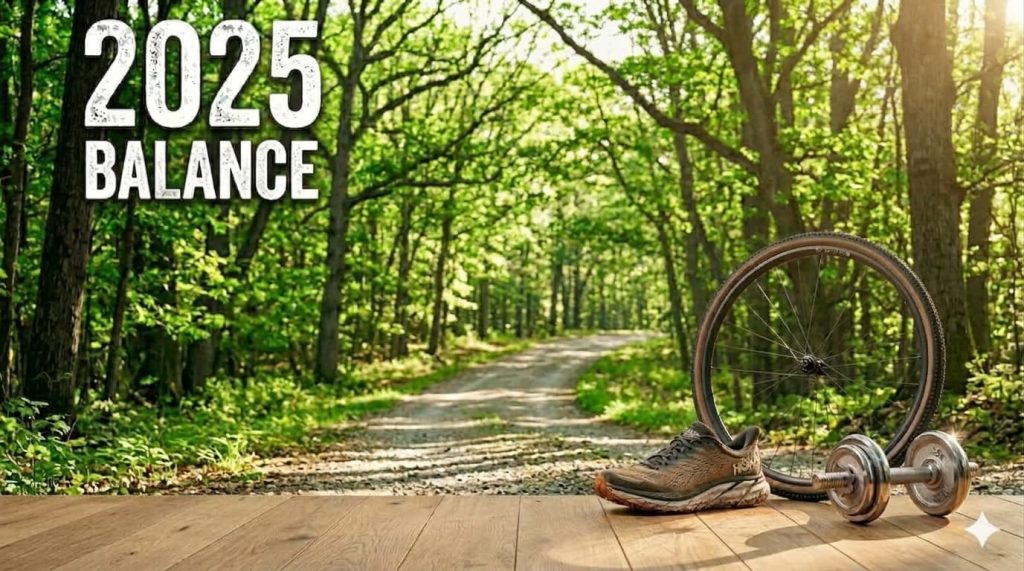
A steady rhythm
2025 continued in the same way: the alternating rhythm of the three sports brought results. Since the beginning of the year I had kept up running two to three times a week, and to my great delight by May I was once again steadily back at ten-kilometer distances. Since then that has once again been my minimum. It took me almost two years to get back to the same place. Not exactly the same, of course, because I do not run as many times in a year, but to be honest I also feel the beneficial effects of that: it is much rarer for one of my joints to ache. It does happen, but mostly when I increase the load.
Weather and flexibility
Since I now run roughly three times a week, weather-related disruptions are rarer too: when there is a real risk of storms, I simply swap the day’s plan for strength training, which I can do at home. And if the weather is really beautiful, maybe I choose cycling instead.
Thanks to that, however, every single run has become a small celebration for me. I value each occasion much more than I did when it was the most ordinary everyday activity. The fact that I can still — or again — easily run ten kilometers in the same amount of time several times a week is reason enough to celebrate. Milestone numbers come less often now, so I enjoy each one more. In 2025 I passed sixty thousand kilometers. Much later than I expected, but I passed it, and with good feelings. I no longer wear out two pairs of running shoes a year, only one.
Still a runner
But I am still addicted in the same way, that is, a runner in spirit, with all the joys and benefits that brings. When I travel, the first thing I do is still to scout the running routes around my accommodation on Google Maps. I cannot do the other two sports just anywhere; only running works like that.
As winter approached, I cycled less and increased the number of runs, once again bringing the monthly total above twenty sessions, which is equivalent to five runs a week. That is now almost the old pace, with strength training twice a week in the remaining time. This means I have at least two rest days from running each week — and I can feel that it does me good. My body gets a completely different kind of load, which it needs, and now I miss it just as much when it is left out as I miss running. The bike, my old love, is now only second fiddle. Over the years running has become so much a part of me that this is how it will stay forever. But as a complement it is ideal.
A better balance
And because it is so strongly tied to the weather, it gets some priority in the main season too, meaning that if my schedule and the weather allow it, I will sometimes choose it instead of running. But its supplementary role does not change.
In one respect, though, there has definitely been progress: I can exercise every day, a rest day is not necessary, and I am never tired. In fact, I also spend more time on it, because cycling takes two hours at a time. Thanks to the alternating training, one activity or another is resting every single day. After a few years of personal experience, I can only recommend this alternating training format to anyone who is already approaching sixty. Three runs, two bike rides, and two strength sessions — that is the normal weekly program. It is completely balanced, every activity gets a rest day, and each one works different muscles. The three runs take the lead, and mentally that alone is a perfectly good minimum.
What it taught me
I have found a balance in sport and in the joy of movement that I did not know before. But I needed the ordeal to get there. Without it, this state would never have arrived. Was it worth it? Did I come out ahead because it happened this way? Most likely yes, that is what I have to say. My life has become richer, new chapters have opened before me.
I also find myself wondering that if I had known in advance how things would turn out, what I would have done differently. I would certainly have avoided the illness; for example, I would have come by plane rather than by bus. But would it have been better to live with that uncertainty hanging over my head, wondering when the illness would strike? Now one medicine has removed most of the danger. It is true that before then I had never taken any medicine at all, and had not even been to a doctor; I was completely healthy. But I also did not know about the risk, even though it is better to be aware of it. So I can consider myself lucky, because I did not have to give up running for good; it remained part of my life, part of my everyday routine. Without it, perhaps I would not have overcome this illness at all once it appeared.
Several of my acquaintances say that here is someone who has spent her whole life doing sport, never drinks alcohol, does not smoke, does not drink coffee — and yet this still happened to her. What is the point of all that, then? Better to burn the candle at both ends; everything is useless anyway. I feel sorry for them, because they do not see what I see in it: that I got back on my feet, that after a little time I could be right back where I was, and even fitter, since twenty years ago I would not have been able to do the strength or bodyweight exercises I do today. Without the illness I would never even have thought of trying them, and now I enjoy their benefits.
2025: 172 sessions / 1,621 km
Since 2002: 5,842 sessions / 60,907 km