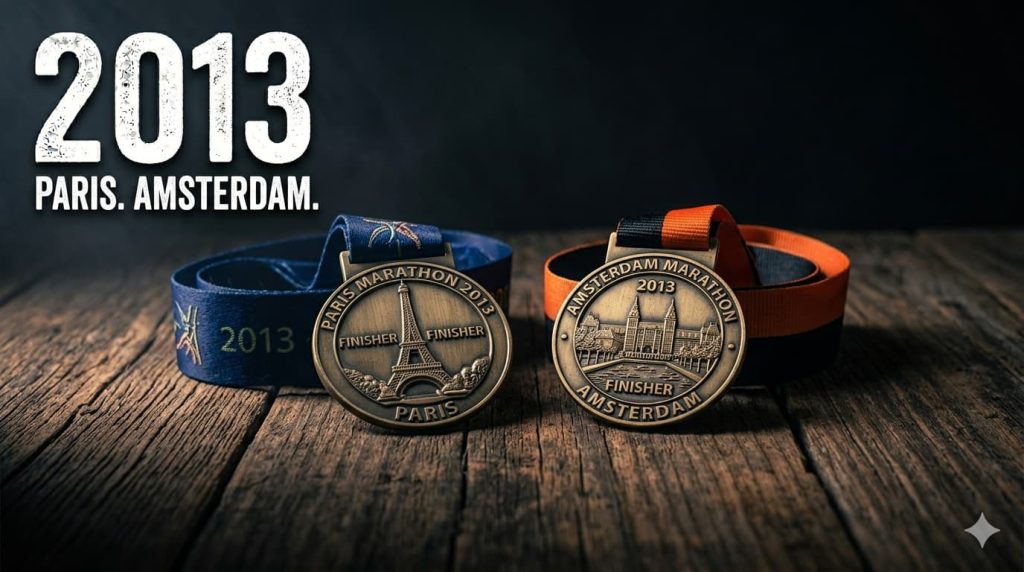
This year was soaked in marathon euphoria. As I mentioned at the end of last year’s entry, the moment I crossed the finish line I started planning the next ones. I wanted to relive that rush again and again. I pencilled in two marathons: Paris in the spring, Amsterdam in the autumn. And to build race experience, I added a half marathon a month before Paris.
The Build-Up
Oddly, I approached the March half marathon with almost the same apprehension as a full marathon: will I make it? The doubt was baseless — since the end of the previous year, every week had included at least one run of twenty to twenty-four kilometers. I knew that if I held that pattern, a marathon was within reach at any time. January was cold, February seasonal, and nothing held back the preparation. The half went well: comfortably under two hours. A taste of the race atmosphere, but no euphoria at the end — the distance was too short for that.
Mid-March brought one more stretch of minus seven and snow, followed by the nightmare of slushy, refrozen roads. But the preparation was flawless. I felt ready. This time, the sub-four was within reach.
Paris
Race morning was bitterly cold. I debated what to wear. With fifty thousand runners on the start list — even more since then — you had to be in the start zone early. I stood in near-freezing temperatures for at least thirty to forty minutes before my wave was released. I was completely numb by the time I started, but the atmosphere and the adrenaline carried me through.
This time, with better-chosen music, I ran at my own pace, alone, the entire way. The sheer number of people was staggering. Running on streets that are normally choked with traffic, closed off for us, cheered on by enormous crowds behind the barriers — especially toward the end — was an experience in itself.
The hydration was excellent. In Budapest there had been cups; in Paris, 30 cl bottles of mineral water, perfect for carrying between stations. The right size to hold, not too heavy, always fresh water in hand. I swapped at each station if I hadn’t finished the previous one. I paid much closer attention to hydration and gels this time — I didn’t want to fade like the first time.
One hazard I hadn’t expected: discarded banana peels turning sections of the road into ice rinks. I saw some serious falls. It would be nice if every runner took a moment to dispose of them properly instead of tossing them underfoot — the volunteers couldn’t get in to clean up when the densest part of the field was passing, and that was exactly where I was, targeting a four-hour finish.
I passed the half at 2:01. Slightly over two hours, but I’d planned to push at the end if I had the energy. I felt good. No anxiety about bonking. My instinct about skipping ready-made training plans and listening to my body was confirmed: run a half every weekend for two or three months, and the full marathon is there whenever you need it. That rule has never let me down.
Past thirty kilometers, I wasn’t excessively tired. I held the pace, still cautious. My legs were getting heavier, but manageable. At thirty-six, I felt it was time: I gave everything I had left and started picking up speed. From there, I was the one passing people. Almost nobody passed me.
At forty, fatigue crept in. I glanced at my watch. Two kilometers to go, but each step was harder. And then came an unexpected blow: my long-sleeve cotton shirt started chafing my nipples raw. Within a few kilometers, pinkish-red stains appeared on both sides. I tried holding the fabric away from my skin, but the sweat made it sting even worse. A lesson learned the hard way.
Approaching the finish, past the forty-second kilometer, I saw the clock. I remembered how long after the gun I’d actually crossed the start line, did the mental arithmetic, and realized: if only by seconds, I could make it. And I did. 03:59:47. Under four hours. The dream fulfilled, on my second marathon.
Finisher shirt, goody bag — and the euphoria I’d been craving. This time it came. But it lasted a day and a half at most, not the days it had lasted the first time. The muscle soreness, on the other hand, stuck around just fine.
Recovery and the Summer
This time I went back to running after five days instead of a full week. Ten kilometers first, but it felt like a lot, so I dialled back to seven or eight for a few days — still better than complete rest. A month later I started building the weekend distances again: sixteen to eighteen, then a twenty-kilometer race where I encountered something that has since become common: no cups at aid stations. Instead, runners received a reusable bottle in their race pack and filled it at taps or from volunteers with hoses along the route.
The summer preparation went smoothly: the usual twenty to twenty-four on weekends, then a sixteen-kilometer race in late September as a final tune-up for Amsterdam.
Amsterdam
On the Thalys express to the city, I sat in the aisle seat. Across from me — as it turned out — sat another runner heading for the same marathon. We traded running stories the entire way; the trip felt short. He told me about an acquaintance who’d fallen ill a month before a marathon, couldn’t run for four weeks, then recovered just in time, started — and ran the best time of his life. Simply because he was rested. That reinforced my conviction that the worst thing you can do in preparation is overtrain. Which is exactly what I’d done before my first.
At the expo I picked up my race number and the shirt — orange, as befitting the Netherlands. For the race itself, I wore my pride: the green Marathon de Paris finisher shirt. I wanted everyone to see I’d already done it. I spotted someone whose shirt listed every marathon he’d completed, with dates and cities on the back. I liked the idea. Among them was “2012 New York” — but that year’s race had been cancelled due to weather. I pulled alongside him mid-race and asked if the New York marathon had been tough. He laughed and said he’d make up for it, not to worry.
The night before, the best pasta party I’ve ever attended: all-you-can-eat under a tent at the Olympic Stadium finish area. Tickets sold out fast, but I was glad I’d grabbed one.
The start and finish were both inside the Olympic Stadium — a unique experience. Starting and finishing in a real, packed, roaring stadium as an amateur runner is something I think you remember for the rest of your life. The course was well chosen: the canal-side stretch got slightly monotonous, but the windmills lifted the scenery. Excellent organization, free gels at the aid stations, the Rijksmuseum, the Vondelpark. The only difficulty was the cobblestone sections. About twenty thousand runners — the right number for those streets.
I ran the entire distance without walking and shaved a minute off my Paris time: 3:58:41 net. I was especially lucky with the weather: no rain during the race, which in October in Amsterdam is apparently not guaranteed. A few hours later, the sky opened and it poured for hours — but by then I was enjoying my memories from a warm hotel room.
I left my shoes in the hotel room next to the bin. They’d served their purpose through the entire preparation and the race. I wouldn’t have swapped them for a new pair beforehand — and emotionally, it mattered that I’d run the race in the shoes I’d trained in.
What’s Next
The end of the year was already spent preparing for the next two marathons. No stopping. One near Paris, and one in Berlin — I applied in October and was fortunate to be drawn in the lottery on the first attempt. That was my first encounter with the marathon ballot system. Paris had crashed its servers with the flood of applicants. Amsterdam was still easy to enter. But Berlin is different. The Berlin Marathon is exceptional. That story belongs to next year.
2013: 309 runs / 3,792 km
Since 2002: 2,602 sessions / 26,604 km