The year followed the now-familiar pattern: preparation for a spring marathon and an autumn marathon. But life had added a new layer. The previous autumn I’d started a year-long course to learn a new profession, which meant a heavier workload and less flexibility. Running shifted to the afternoons and early evenings. That’s when I truly experienced how much a run can restore you after an exhausting day — not just physically, but mentally. That hasn’t changed to this day. I have never once come back from a run feeling worse than when I left. The old saying nails it: Have you ever felt worse after a run? Whoever coined that knew exactly what they were talking about.
The Spring Marathon
The preparation was the usual: weekend distances of twenty to twenty-four kilometers until the week before the race, then just the standard ten to twelve. It worked again.
The marathon was held on May 1st. Unlike the previous ones, this wasn’t a big-city race. The start was in a small town square; the finish in a different town entirely, since the course wasn’t a loop. The organization was flawless. Volunteers directed cars into a massive parking area with such precision that every vehicle ended up parked as neatly as if each spot had been painted. Runners arriving by train were bused from the nearest station. Bags checked at the start were transported to the finish.
The race ran through a dozen small towns, across fields and gentle hills — a completely different feel from the big-city marathons. On the open stretches, the wind was fierce. By the twenty-five-kilometer mark, many runners were already walking.
I wasn’t in that danger, but I had my own scare. Around twelve or thirteen kilometers, a sharp pain shot through my right knee. It hurt badly enough that I genuinely worried I wouldn’t finish. I was already thinking about reaching the next aid station to withdraw. Then, just as suddenly as it had appeared, the pain vanished. By fifteen kilometers, quitting was the furthest thing from my mind.
I passed the half at around two hours and kept going. My legs were getting heavier, but on that course the next town was always the next target: just three more villages to the finish. That kept me through the low points.
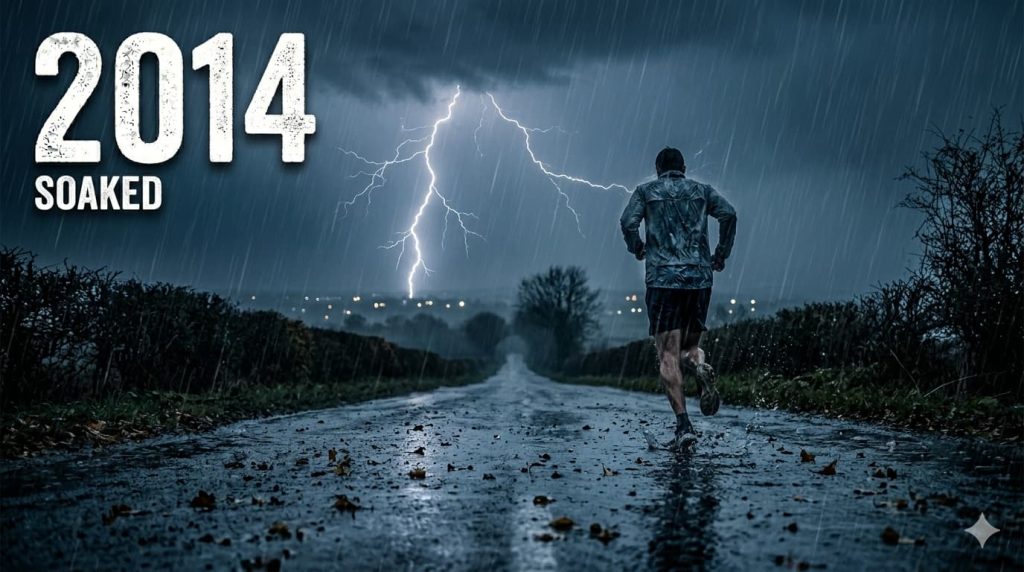
Near the end, massive storm clouds rolled in and the wind picked up sharply. At forty kilometers, it looked like the sky could split open any second. The course tilted downhill toward the finish, so I pushed the pace — not to beat a time, but to stay dry. I reached the small sports ground, sprinted onto the track, and the first fat raindrops appeared. I crossed the line just before the heavens opened. Standing under the tent, I watched my fellow runners finish in sheets of rain.
The urgency had done me a favor: 3:55:19 — my fastest marathon ever, by accident. On the drive home, the rain was so intense we had to pull over. My thoughts were with the runners still out on the course.
The euphoria, though — despite the record time — was gone. A few hours at most. The feeling from the first marathon never returned, and honestly, I missed it.
The Wallet
Mid-July, on my usual route, a rollerblader passed me on the bike path. A few hundred meters ahead, I saw something fall. He didn’t notice and kept going. When I reached the spot, it was a full wallet: ID, driver’s license, bank card, health insurance card, a little cash. He was too far ahead to call after. Inside was a business card with a phone number. I called as soon as I got home. He was extremely anxious — and extremely relieved when I told him everything was still there. He came by a few hours later to collect it.
Berlin
Two and a half weeks before the race, I stopped the long runs. I felt ready.
The race pack was collected at a gigantic expo in an old airfield. I bought souvenirs — I knew this race had a special atmosphere. There was no free finisher shirt; you had to buy one. I bought a cotton tee with the course map and “Finisher” printed on it, pre-empting success. Weeks later, the online shop ran a clearance sale on 41st Berlin Marathon merchandise — I ordered several items I still wear today. I even have a few still in packaging. I sometimes wear race shirts on everyday runs, and each time, I relive a little of that race.
Every runner received a magenta rubber bracelet. After the race, a shop would engrave your finish time on it for free. In Amsterdam I’d picked up a gold bracelet with the 2013 emblem. I wore it to every marathon after that, along with the Berlin one. For runners, these are lifetime keepsakes.
The field was enormous, comparable to Paris. I stood packed in the start zone for over an hour. By then, any warm-up was long gone. That’s when a thought surfaced for the first time: I’ve had enough of this. I’m not waiting ninety minutes crammed in before the start again. I’d rather run a solo marathon at home. After five marathons, the enthusiasm was fading.
But once the race started and I was running through the famous squares and landmarks, living what I’d only seen on YouTube — the disillusion evaporated. I was enjoying it again.
A few memorable moments. A Japanese runner dressed as Jesus, carrying a cross. Someone held up a sign at the twenty-kilometer-to-go mark shaped like a beer stein — alcohol-free beer awaited at the finish. Just past halfway, another sign: 02:02:57 New WR — a new world record had been set and the winner had already finished while I was barely past halfway. I had a good laugh.
In the second half, a particular feeling took hold: I have nothing left to prove. I’d achieved what I wanted. I could run a marathon under four hours, repeatedly. From that point on, it was no longer about performance. It was about pleasure. I watched the people, the runners, and I wanted to enjoy everything. From then on, every marathon was about enjoyment.
I finished in 4:07:02. I hadn’t rushed the end.
The next day, going to get my bracelet engraved, you could spot the marathon runners a mile away: boarding a tram was a serious athletic challenge. I remember a margarine advert showing exactly this after the London Marathon. The tagline: after a marathon, only one part of your body is grateful — your heart.
A New Chapter
I didn’t plan a marathon for the following spring. A move, a new job, a new way of life lay ahead. Everything went back to the classic script: ten to twelve kilometers, at least six times a week. In November, almost without noticing, I passed thirty thousand total kilometers. The last days of the year I spent running new routes in a new city, searching for the ideal path, in the cold.
2014: 315 runs / 3,787 km
Since 2002: 2,917 sessions / 30,391 km