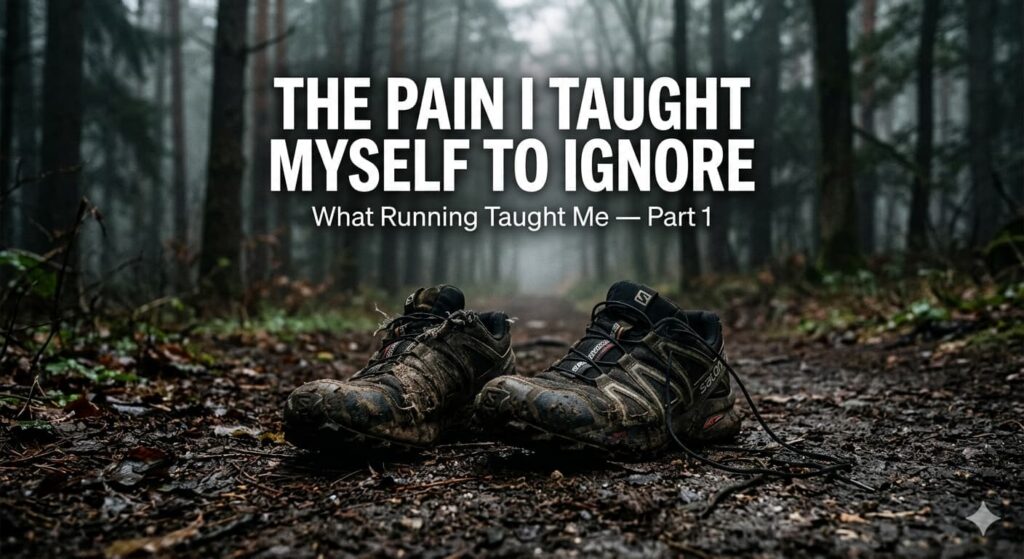
What Running Taught Me — Part 1
I started running in 2002, at thirty-three. More than twenty years have passed since then, and I think I only truly understood what running is — right around the moment I nearly lost it. But that story belongs to Part 2. First, I have to tell you how I got there.
When running was just one leg of the stool
In the beginning, I didn’t only run. I started with cycling, then added running on top of it, and for a while the two got along well. About a hundred and fifty rides a year, about a hundred runs. Roughly every third day was a rest day.
Then in 2006 — family, a move, a new job — I dropped cycling. From one month to the next. Everything that had been split between two sports suddenly funneled into one. Running, running, running. My annual kilometers jumped two and a half times overnight.
I was thirty-seven. My body still adapted easily. I wasn’t carrying extra weight, my fitness was steady, and I paid close attention to shoes — neutral models, matched to my weight and to sixty or seventy kilometers a week. When I first started out, someone told me something I never forgot: “You can replace your shoes, but you only get one set of joints for life.” Over the years, I added a little to that sentence. You can replace your shoes — and it’s worth doing. But the joints? One set. That’s it.
Fifteen quiet years
Through the end of my forties, my body held up. I ran eight marathons in four years and was never sidelined by injury. I was careful — I scaled volume gradually, I replaced shoes in time, I listened to what I thought was enough. Fifteen years passed without my body raising its voice.
Then, somewhere around fifty, the first small signs appeared. A stab in the knee. A stab in the ankle. Literally — as if someone had jabbed a knife in. A few meters of limping, then gone. I’d keep running as if nothing had happened. When I finally got to swap asphalt for forest trails for a while, the stabs came less often — but they never fully disappeared.
By fifty-three or fifty-four, a day with nothing at all aching had become rare. These weren’t big pains. They didn’t keep me from running. But they were there. Always there. And I didn’t yet know how many years that little daily training — learning to carry pain — had been going on. Or what it would eventually cost me.
The calf that stopped me
I still remember my first really sharp moment. Early morning, forest trail, the sixth kilometer — and a pain tore through my left calf that forced me to stop for minutes. Not a joint, not a knee; the muscle, just below it. I couldn’t walk. I limped home, and I worked that entire day with my leg propped up on a chair. Lucky for me, I had a desk job. Standing wouldn’t have been possible.
That’s when I discovered what has been my emergency exit ever since: Nordic walking. Almost the same energy cost as running, just slightly slower — and far, far easier on the joints. Two days later I was out with the poles. The day after that, I was alternating running and Nordic. The day after that, I was running the full distance again.
Three days off. To someone outside running, that’s nothing. To someone who depends on running the way I do — someone who sees himself running down the street even on the days he doesn’t run — three days is longer than I can really explain. There’s no point trying. Either you get it or you don’t.
Pain tolerance, as a skill
Long-distance running teaches you to master pain. Blisters, chafing, legs like lead the next morning — they come with the territory, and after a while you stop noticing them. For a competitive runner, that skill is worth gold.
But pain tolerance isn’t just a skill. Past a certain point, it becomes a liability.
To an experienced runner, a calf ache is nothing. There are off days and good days. Sometimes you’re tired for a stretch, sometimes everything flows. That’s how runners read their own bodies. And that’s exactly why, when real trouble finally knocks, we’re the ones most likely to dismiss it.
I thought I knew what pain was. I thought twenty years of practice had taught me to tell the serious from the trivial. At fifty-four, I found out I had no idea.
To be continued. In Part 2, I’ll tell you how my body taught me what running alone never could.