
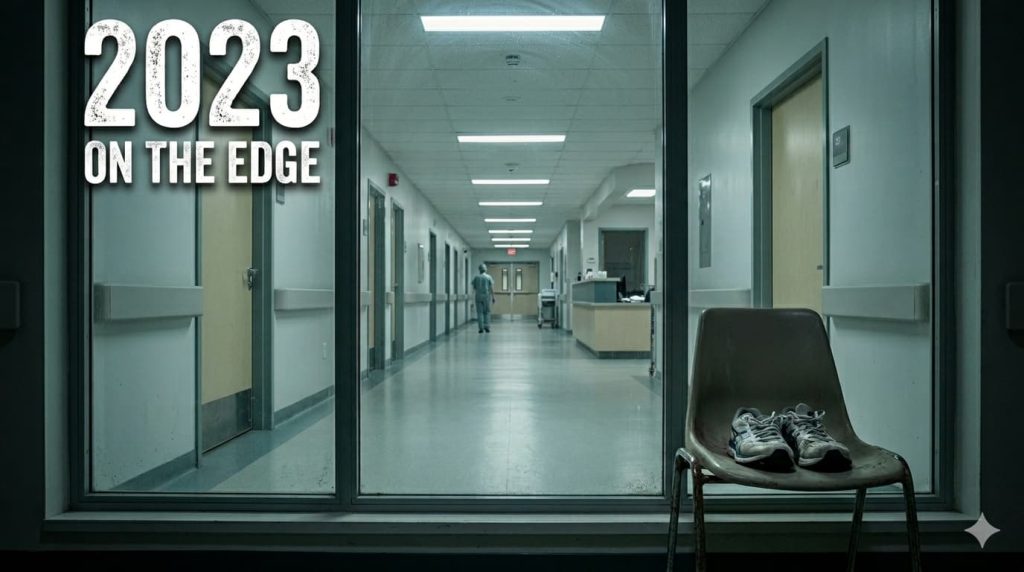
This year changed everything, although it started very well. January opened with unusually mild weather — I ran in shorts during the first week, ten to thirteen degrees, before temperatures settled back to the normal January range around zero. In February, I travelled to my home country for a week, continuing the daily runs there as always; only the bus travel days were skipped.
The Last Half Marathon
On May 1st, following the previous year’s resolution, I entered a half marathon again. I finished in 1:58:53, under two hours. But this time, by the ten-kilometer mark, I already felt that this was no longer my thing. I wouldn’t enter another race. The memories were beautiful, but enough was enough. The distance didn’t break me — I hadn’t trained specifically, my fitness was fine — but the desire had gone. I noticed it slipping away.
The Journey
I was still attending a training course until early July, so running fit into the afternoon slot. The audiobooks made it the most anticipated part of the day. It had also become clear that another move was ahead in July — back to the other country, for at least a few months.
The trip — by bus, nearly a full day — fell on the last day of the course. The bus left in the evening. I remembered from previous trips that if I ran before boarding, I slept much better on the overnight journey despite the uncomfortable seat. So I didn’t skip the run. My sweat-soaked clothes had no time to dry, so they went into a sealed plastic bag inside the largest suitcase, as always.
It was around thirty degrees. I had two very heavy suitcases and a heavy backpack. The journey to the bus station took over an hour, with transfers and a lot of walking and stairs. I hadn’t expected it to be that hard. On the bus, a pleasant tiredness took over and I knew I’d rest until arrival. On these routes, it’s best not to drink too much — the toilets don’t always work and the stops are rare. I stuck to that rule, even though it was hot. Fortunately, the air conditioning was on.
I’ve described this journey in detail elsewhere (Part 1 and Part 2). It became a lesson for life.
The Collapse
At the end of the trip, my ankle was swollen and my right knee and calf were hurting. I didn’t think much of it — after a journey like that, it wasn’t unusual. The next day I wanted to resume running, as I always did. But something was wrong. I was getting weaker, shorter of breath; I’d tire after just a few kilometers. Eventually, even Nordic walking barely worked for more than a few kilometers.
As it turned out, the pain and swelling had been signalling a serious, life-threatening condition. In mid-August, I was hospitalized. I spent several days in intensive care — I’d been between life and death — and the doctors banned all running, all sport, for months.
Stillness
This was entirely new. I’d never been told I simply couldn’t run. Strict bed rest for weeks, in the hospital. But strangely, I didn’t crave movement the way I expected. My body wasn’t asking for it. I needed to rest, genuinely, and I felt it. That calmed me somewhat: there was nothing to be done except lie down and recover. As though twenty years of accumulated fatigue needed paying off all at once.
In September, a severe nerve entrapment struck. For days I couldn’t move — literally; moving my leg was agony. The acute pain lasted a week, then gradually eased. I resumed yoga — I’d been doing it daily for years, half an hour each morning — but more intense exercise had to wait for another check-up in late October.
By then, thankfully, all consequences had cleared and I was given the green light for cautious movement, even running. The doctors told me to move as soon as possible — they said my survival was largely thanks to my fitness. My lungs had been affected too, so I was anxious about what that meant for the future. I’d read about people who developed lifelong complications and were never the same again.
The First Run Back
Three and a half months had passed since my last normal run. Somewhat ambitiously, trusting that two decades of running had hardened my body, I set a target of five kilometers. The result was mixed. The good news: my lungs were fine. No breathlessness, no suffocation — and I’d been terrified of that, remembering how the shortness of breath had crept in before the hospitalization. But the nerve entrapment had left its mark: every running step sent a jolt through my hip. That, not the lungs, was what stopped me from running again. I fell back on Nordic walking — the ultimate safety net this time. From late October through November, I increased the distance from five to eight kilometers, going out at least five times a week. I couldn’t match the intensity, but I was determined to hold the frequency, to slow the fitness decline even if I couldn’t stop it.
In early December, during a better spell, I tried running again: five kilometers. Lungs fine; hip not. The next day I repeated the experiment, hoping movement would sort it out as it had many times before. No change — every step was uncomfortable. I switched back to Nordic walking, eight kilometers steady, and inside I was devastated. I felt running was over. Over forever. I’d always dreaded the day when it would end — when it worked yesterday but not today. The transition here was gradual rather than sudden, but the outcome was the same. I had to accept that from now on, Nordic walking was all I had. At least I could walk. From that point on, I added the Nordic walking distances to my running totals — until then I’d always counted them separately.
Overall, the year’s statistics weren’t catastrophic — everything was fine through early July — but the drop was stark. It filled me with sadness, and with a small measure of joy that I was still going, even if differently.
2023: 220 sessions / 2,064 km
Since 2002: 5,602 sessions / 58,824 km