
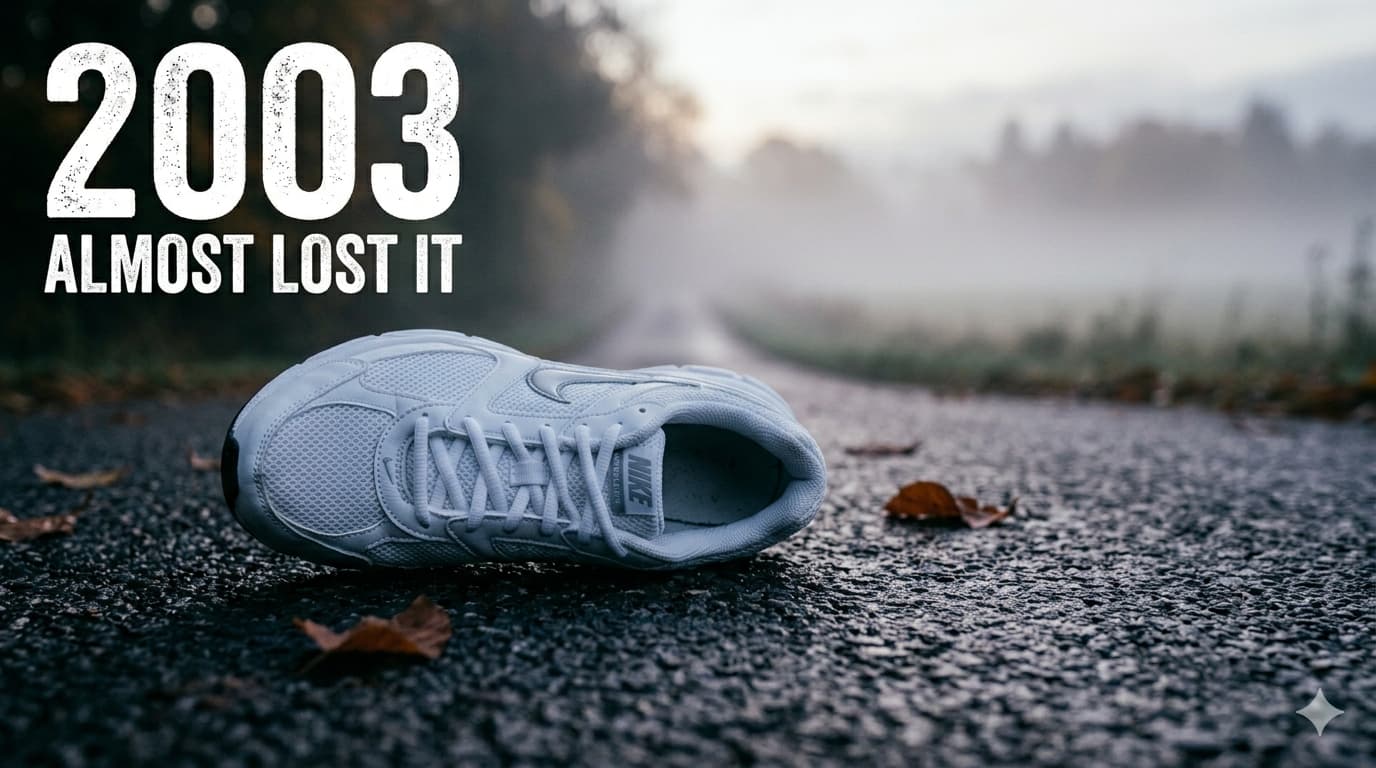
The year started with a gift: a brand new pair of Nike Dart III — white, clean, perfect. My first ever running shoe that was truly mine. Until then I had been running in a borrowed, worn-out pair. This was different. This was mine.
I learned something immediately about white running shoes: they are beautiful when new. Heartbreakingly beautiful. And then you take them out in the mud, in the slush, in the January ice — and they never quite recover. I know now to choose darker colors. But that lesson cost me one pair of white Nikes and about two hundred kilometers of guilt every time I looked at them. More on shoes in another post — I’ve worn through 45 pairs over 62,000 kilometers, and I have opinions.
What that new shoe gave me, beyond its cushioning, was a ritual. From that point on, my running shoes never touched any other ground than running ground. I put them on and something shifts — mentally, physically. I become a runner. I go nowhere else in them, I do nothing else in them. A friend once told me he wears his running shoes casually first, then switches to running in them. I was genuinely surprised. Those shoes are the one thing standing between your joints and the road. They deserve better than everyday wear. I still believe this.
January was brutal that year. Minus five, minus ten degrees, regularly. I didn’t stop. But I learned — the hard way — what actually makes winter running impossible. Not the cold. Not even the snow. It’s the ice: the daytime-melted, night-refrozen, car-compacted, invisible ice. On one January morning I made it exactly 150 meters from my door before falling three times. I turned back. That is one of the very few times in my running life that I started and didn’t finish.
Deep snow above the ankle is another story — exhausting, ankle-twisting, not worth the risk. And then there’s the hidden trap: snow covering thin-iced puddles filled with mud. You step on what looks like solid ground and sink to your ankle in freezing brown water. My beautiful white left shoe looked like it had been dipped in milky coffee. It took several snowy runs to get it white again. That, at least, is one advantage of running in snow.
That winter built something in my technique though. Years later, when I ran in forests and open fields in winter, I knew instinctively how to move on uncertain surfaces. The city ice had taught me.
Spring brought slush — the transition season that is almost worse than winter. Slush fills the gaps in your shoe sole and turns every step into a skating attempt. One serious soaking and you wait days for the shoe to dry at room temperature — never use heat, it deforms the material and damages the fabric. Mud is another enemy of the shoe itself: don’t leave it dirty for days. The shoe earns a few minutes of care. It repays you for hundreds of kilometers.
By spring I had settled into a stable rhythm: one to two runs per week, regardless of conditions. Running was becoming part of me.
Then April happened. A pastry from a bakery gave me salmonella. Three days of misery — and six kilograms gone. For the first time in a long time, I was under 100 kg. I decided not to waste it. I changed my diet, kept moving, added more cycling as the weather improved. By end of summer I was back to 82-83 kg.
And that’s where I almost lost everything.
The cycling was going beautifully. I was lighter, stronger, covering 100-kilometer rides, averaging 32 km/h. Every minute of it was joy. The good weather, the speed, the freedom — everything pulled me back toward the bike. Running started to shrink. May: five runs. June: five runs. July: two. July 2nd and July 14th.
Looking back, I know this now: if I had skipped those two runs, I would have stopped running entirely. I would have become a cyclist again and never looked back. I pulled running back from the grave with those two sessions. I didn’t know it at the time — I just went. But I went.
August: four runs. September: four. The minimum. But enough.
When autumn came and the cycling season wound down, I started running more again. And now I was lighter — really lighter — and it showed. Running felt different. Easier. Almost enjoyable in a new way. The enthusiasm returned, and with it, the classic beginner’s mistake.
November 13th. Foggy morning. Minus two degrees. I ran 10 kilometers without stopping.
I had never believed I could do that. Ten kilometers, in one go, in the cold, at 34 years old, a man who two years earlier had collapsed after 150 meters. I went to work afterward and floated through the entire day. Pure euphoria.
Then I did it again. And again. And again. My shorter runs crept up to 8-9 kilometers. I was unstoppable.
Until December, when my knee told me otherwise.
It couldn’t handle the sudden load. I had gone too far, too fast, too soon — the oldest mistake in running. I had no choice but to pull back to 5.5 kilometers per run. It took nearly two years to work back up to 10 kilometers gradually, patiently, the right way.
The year ended quietly, carefully. But something had permanently changed.
I remember Christmas dinner that year. The table was full, the food was rich, the family was gathered — and I felt terrible. Overfull, heavy, restless. I had to go for a run. The family objected. I went anyway.
Six kilometers later I came home lighter, calmer, happier. The rest of the evening was good.
That feeling has never left me. I hope it never does.
2003: 73 runs. Approximately 500 kilometers.