
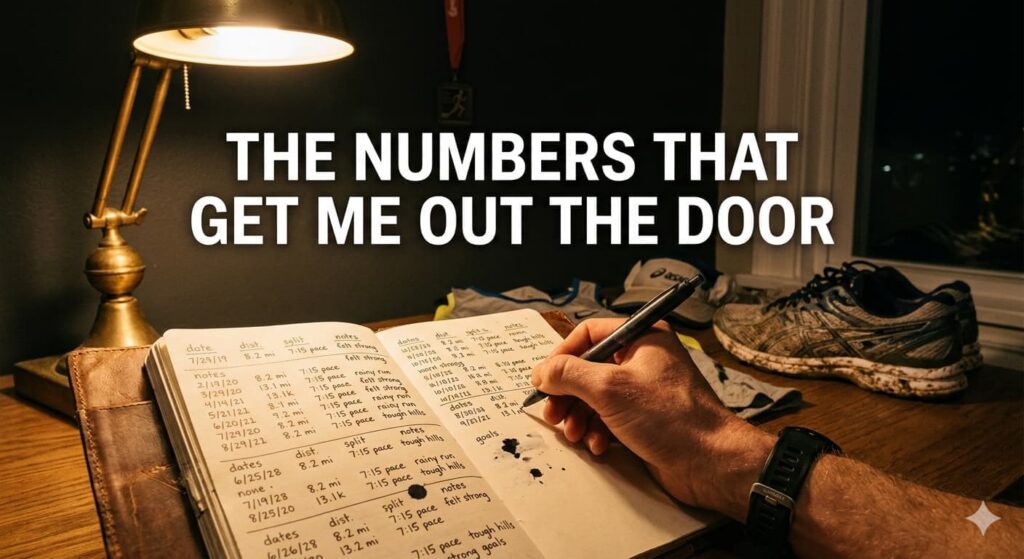
It was a foggy December morning. Dark, just past five. I\’d barely slept, I was groggy, and I didn\’t want to go out into the minus three. I got dressed slowly — arguing with myself, secretly hoping something would come up that would let me admit it was smarter to crawl back under the covers for another hour. Nothing did. Then a number came to me: two thousand seven hundred. I was sitting on two thousand six hundred and ninety-nine runs. One more, and the number would be round.
So I went.
The log I keep for myself
I’ve been keeping a running log for twenty-five years. No Strava, no Garmin Connect — those didn’t even exist when I started. It’s a handmade system in a Word document that I’ve been refining, piece by piece, ever since. Every day, when I get home or later in the evening, I sit down and enter that day’s run. Date, time of day, distance, temperature, weather — and if something notable happened, a word or two about it.
A normal, uneventful entry looks like this: 20:10/pm18C sunny
Let me translate. It’s the twentieth of the month. I ran ten kilometers in the afternoon. It was eighteen degrees, sunny. Nothing notable happened.
The log has abbreviations I’ve built up over the years. Time of day: em = early morning, pm = afternoon, ev = evening. For rain I have a whole scale: drz (drizzle), lht (light rain), rain, and if it’s a downpour, I add one, two, or three exclamation marks. Three exclamation marks means I was soaked to the skin in ten seconds. Then there’s sunny, changing (ch), cloudy (cld), heavily cloudy (hcld), overcast. There’s icy, icy-ridged, slushy, snowy, melting snow. There’s the category of “snow flurry” that gets its own code.
These aren’t decorations. They justify the shoe choice. If it’s raining, I wear my Gore-Tex pair — a W at the end of the line marks it (that’s a Winflo Shield, my current model). If there’s no mark, it’s the regular shoe.
If something happens — a run-in with a dog owner, an unusually beautiful full moon, a near-miss with a cyclist, the apricot trees in bloom — that gets noted too, in a word or two. So I can go back years now and know exactly when something happened. The log is an extension of my memory.
Twenty-five years of weather
Something accumulates over twenty-five years that you didn’t plan for: a personal weather archive. I know exactly when winters were mild, when springs were wet, which year the cold arrived late. When someone tells me “the weather this year is strange,” I can flip back and see that it was just like this ten years ago. Or that it wasn’t.
I never set out to build it. I just started writing down the weather because it determined the shoes, and twenty-five years later there’s a small, personal climate history.
The private celebrations
But the biggest gift of the log isn’t memory, and it isn’t weather statistics. It’s this:
Almost every run has something worth celebrating.
I know exactly how many times I’ve run this week, this month, this year. The monthly count reaches ten, fifteen, twenty. The annual count reaches fifty, a hundred, a hundred and fifty. The all-time log is closing in on six thousand. My current shoe is coming up on a thousand one hundred kilometers. The first run in a new pair always gets a special date marker.
Each of these numbers is a small celebration waiting to happen. Nothing huge. But on a foggy Wednesday evening, in the dark, when I don’t want to go out, and it occurs to me that this would be my three thousand three hundredth run — I go out. And somewhere around the sixth kilometer, it occurs to me that I’m also about to cross a hundred kilometers in these shoes. Then that it’s the nineteenth time this month.
These numbers aren’t about performance. I don’t even track pace. I’m not racing anyone else, and I’m not racing myself either. The numbers I keep are about showing up. About going out. The twenty-seventh. The twenty-eighth. And the twenty-ninth too.
Why it works
Over the years I’ve spoken with a few people who took up running and then stopped after a few weeks or months. The most common explanation wasn’t “I got tired” or “I got injured.” It was “the weather turned cold” or “I lost my motivation.” Every run had become the same. Nothing to measure against. Nothing to look forward to.
The other extreme I’ve seen is chasing improvement — and quitting the day the numbers stop getting better. Why bother, if I can’t improve anymore?
The log dissolves both traps. Not because it “motivates.” Wall-poster quotes don’t do this. It works because every single run enters a process that has a past and a future. The sea is made of drops, as we say. Today’s run isn’t a lonely event — it’s the three thousand nine hundredth in a line that started in 2002. Soon comes the three thousand nine hundred and fiftieth, then the four thousandth: that one will be a bigger celebration. This isn’t performance pressure. It’s a continuing story, and I’m the main character.
And on days when nothing motivates me, when my knee aches, when I’ve worked all day, when it’s dark outside — the number is sometimes enough. A round number that won’t be quite as appealing tomorrow as it is today. A number that moves in only one direction: you can only add to it, never lose it. One run away from a milestone. A month whose last day is near, and if I don’t go now, I’ll have twenty-four runs this month — might as well make it a round twenty-five.
And one more thing in the log
There’s one final column in my log that I won’t write about in detail today — it deserves its own post. It records what I was listening to that day. It’s a separate ritual. I’ll write about it next time. Until then: if you haven’t started a log yet, start one. It doesn’t have to be a perfect system. Mine wasn’t on day one either. It just changed slowly for twenty-five years. And every day, when I write in it, it’s a small celebration.
In the next part: the book I only read when I run.