The doctor told my wife he wasn’t sure I’d make it. I’d come to the hospital too late.
I was fifty-four. A daily runner. And I had convinced myself that the pain in my calf was just a pulled muscle. Twenty years of training myself to carry pain — that was the subject of Part 1 — and this is what it had prepared me to believe.
The bus
It all started with a twenty-two-hour bus ride. By the end of it, my right ankle was swollen, and the upper part of my calf — just behind the knee — was hurting. My leg felt stiff. Uncomfortable trip, I thought. Probably pulled something. Nothing serious.
The next morning I went out running as usual. After six or seven kilometers, I had to walk. I hadn’t run out of breath like that in twenty years. Must have been the trip, I told myself, and I finished the distance slowly.
The day after, I went out again. Suffered the whole way through. Running had never been so hard.
The first week off
I decided to take a full week off. I hadn’t done that in years — I figured I’d earned it, just this once.
After the week of rest, something strange happened. I could only run five kilometers — and those were painful. I was shocked by how fast I’d lost fitness. I told myself I’d never take that much time off again.
The next two days, still only five kilometers. I had to accept I needed more rest. Another week off.
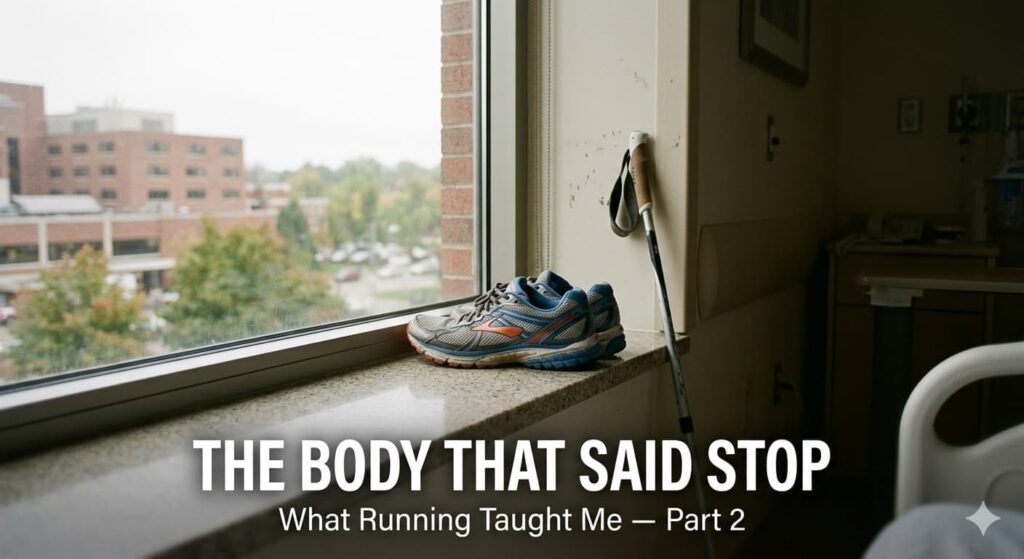
Then I tried again — and like on my very first run ever, twenty years earlier, I had to stop at one hundred and fifty meters. Out of breath. All right, I thought, not giving up. I grabbed my Nordic walking poles and did the ten kilometers on foot. Better than nothing!
The next day it rained. The day after, I went out again — by then even ten kilometers of walking was wiping me out. From there on it was five kilometers, Nordic walking only. Still more than nothing, I kept telling myself.
The diagnosis
The breathlessness started waking me at night. I’d had a sharp pain in my side for weeks. I went to the doctor.
When I described my symptoms, they sent me straight to the emergency room. Laid me down. Told me not to get up — not even for the blood test or any of the other tests.
Thrombosis. Bilateral pulmonary embolism. Serious clots in my entire right leg and in both lungs.
I was in hospital for two weeks. I was told, in no uncertain terms, that running — or any sport at all — was out until the clots were completely gone.
And trouble doesn’t travel alone. The long bed rest pinched a nerve in my back. For a few days the pain was so intense I couldn’t move my leg at all. Then, once I could stand, a nerve pain ran from my hip down both legs, for weeks. I could barely walk.
What died, and what was born
Late October, the scan I’d been waiting for: the clots were gone. Cautiously, I could start moving again.
Of course, I started with running. Five kilometers. My lungs held up — but my hip didn’t. Every step, every slight jolt, sent nerve pain shooting through me. So it was back to the Nordic walking poles, this time for months.
By the end of that stretch, I had started to accept it. Running was over for me. The year’s numbers weren’t bad, really — I’d run until July, one hundred and sixty outings, sixteen hundred kilometers. The rest I’d cover with Nordic walking. But somewhere inside me, it kept hurting beyond words. I came close to crying at the thought that I’d never run again.
Early February, I couldn’t stand it anymore. Out the door to run five kilometers. I made it — but every step was suffering, thanks to the hip.
Three legs
Around that time I kept running into articles online saying the same thing: past fifty-five, you shouldn’t load your body with just one sport. You have to rotate, and strength training has to be part of the mix.
If there was one thing I hated more than anything when I was young, it was strength training. But since I was convinced I’d never really run again — and Nordic walking wasn’t intense enough on its own — I started lifting at home. Bought the basics: a dumbbell set, a folding bench. Put together a one-hour routine and got to it.
Two or three sessions a week, Nordic the rest. And then I discovered something that changed how I thought about all of it: from a runner’s perspective, a strength session counts as a rest day. Meaning: I could train every day. Just not the same way.
After a move, we ended up in a place with ideal cycling terrain. I added the third leg. Nordic walking, cycling, strength — three different sports, three different loads, no need for a full rest day. I settled into this new rhythm. Running itself, I gave up — mourning it, quietly, every single day.
Four and a half kilometers
The hip pain eventually got serious enough that I had it properly examined. I’ll spare you the details — but an excellent rheumatologist freed me from the pain with a single, sudden manipulation. Gone. Just like that.
It was early August. I pulled out my running shoes. A full year had passed.
Four and a half kilometers. That’s what I ran that first time. Not out of breath. Not worn out. Four and a half kilometers back on the stats sheet. And then another. And another.
Running came back. It became part of my life again. Two weeks later, six kilometers. Three months later, eight. Seven months later, ten.
What running taught me
Daily movement stayed. Thanks to rotating activities — two strength sessions, two rides, three runs a week — I don’t need rest days anymore. I’ve been on this rhythm for close to two years now, and — to my own disbelief — nothing has hurt for a long time.
Running is still a heavy part of my life, just a smarter one. Sometimes I feel the urge to run more, every day if I could. That’s when I have to argue with myself — hold on to the other two. I can’t give any of them up. Because tomorrow, one of them might be the only one left.
The illness that came out of nowhere nudged my life into a fuller shape than it had before.
If you’re reading this — and you’re thinking about starting to move — one thing: don’t wait for your body to force the issue. I did. I’m fifty-seven now, and I’m in better shape than I was thirty years ago.
Not because I got smarter. Because my body made me.
This is the second part of a two-part story.